Interference vs Non-Interference Engines: Why It Matters for Your Timing Belt
Interference designs are the majority of belt-driven engines: 20 of the 28 belt-driven engines in the lookup table below are interference. If your timing belt breaks on one, the pistons hit the valves and our line-by-line build-up puts the repair at $2,070 to $5,040. On a non-interference engine, the belt snaps, the engine stops, you tow it home and replace the belt for $400 to $1,500. Same belt failure, completely different bill. Here's how to tell which you have.
The mechanics, in one paragraph
Interference engines pack more compression into the cylinder, which means the piston travels close to where the valve sits when the valve is open. The timing belt is what keeps the piston and the valve from arriving at the same place at the same time.
When the belt fails, the camshaft stops turning. The crankshaft keeps turning under engine inertia. The valves stop opening and closing in sync with the piston. They arrive late. The piston comes up while a valve is still open. They collide.
Non-interference engines have enough clearance between the piston at top dead centre and the fully open valve that even with the belt gone, nothing touches. The engine just stops.
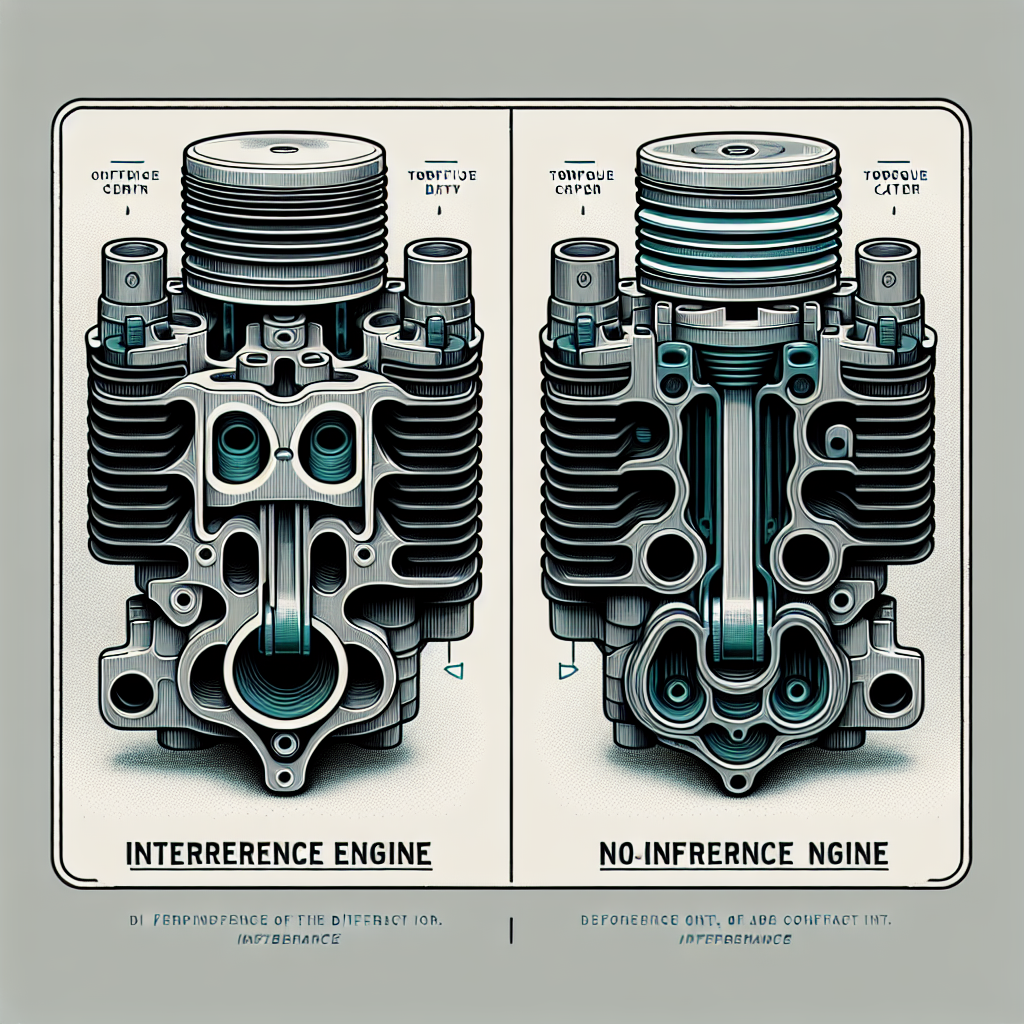
LEFT: Interference (contact between piston and open valves) · RIGHT: Non-interference (clearance)
Cost consequence by failure scenario
Same broken belt. Three different bills.
Belt fails, non-interference engine
Tow + new belt + tensioner + water pump. Engine is fine. The job is the same as a scheduled belt replacement, plus the cost of the tow.
Belt fails, interference engine, caught early
Tow + cylinder head removal + bent valve replacement + new belt. Driver stopped cranking after the belt snapped, no further damage to pistons.
Belt fails, interference engine, severe
Cylinder head replacement, piston damage, sometimes a connecting-rod through the block. Often cheaper to swap the engine than rebuild it.
How to know which you have
- 01
Owner's manual
The most reliable source. Most manuals state interference status in the engine specifications section, often as a single sentence. The maintenance schedule will also list timing-belt replacement at a specific interval if it's a belt; if there's no listing, you have a chain.
- 02
Gates Corporation Timing Belt Interval Guide
The industry-standard cross-reference, used by every shop. Interference engines are flagged with a star (*) or asterisk. Available as a free PDF from gates.com or in any parts-counter binder. Covers virtually every US-market belt-driven engine.
- 03
Engine code search
Find your engine code (sticker on engine block, owner's manual, or VIN decoder) and search '[engine code] interference'. Forums and manufacturer service bulletins typically have the answer for popular engines within the first few results.
- 04
Ask a specialist mechanic
For European engines (Audi 1.8T variants, Volvo white-block, older BMW), online information is patchy. A shop that specializes in your make will know the platform's interference status off the top of their head.
Engine lookup
49 of the most common US-market engines, sourced from the Gates Timing Belt Replacement Interval Guide and cross-referenced with manufacturer service bulletins. Search by model, engine code, or year.
| Manufacturer | Models / years | Engine | Drive | Interference | Interval |
|---|---|---|---|---|---|
| Honda | Pilot, Odyssey, Ridgeline, Accord V6 2003-2017 | J35 3.5L V6 SOHC | Belt | Yes | 105,000 mi / 7-10 yr |
| Honda | Accord V6 1998-2002 | J30A1 3.0L V6 SOHC | Belt | Yes | 105,000 mi / 7 yr |
| Honda | Civic D-series 1996-2005 | D16Y/Z 1.6L SOHC 4-cyl | Belt | Yes | 105,000 mi / 7 yr |
| Honda | Civic, CR-V, Accord 4-cyl 2006-present | K20/K24 2.0L/2.4L 4-cyl | Chain | Yes | Lifetime (no service) |
| Honda | Accord 4-cyl 1990-1997 | F22A/F22B 2.2L 4-cyl SOHC | Belt | Yes | 90,000 mi / 7 yr |
| Honda | S2000 2000-2009 | F20C/F22C 2.0L/2.2L 4-cyl DOHC | Chain | Yes | Lifetime |
| Acura | MDX, RDX, TL 2001-present | J35 / J37 3.5L/3.7L V6 | Belt | Yes | 105,000 mi / 7-10 yr |
| Toyota | Camry, Avalon, Sienna, Highlander 1994-2006 | 1MZ-FE 3.0L V6 | Belt | No | 90,000 mi / 7 yr |
| Toyota | Sienna, Highlander, Camry V6 2004-2010 | 3MZ-FE 3.3L V6 | Belt | No | 90,000 mi / 7 yr |
| Toyota | Tacoma, 4Runner, T100 1995-2004 | 5VZ-FE 3.4L V6 | Belt | No | 90,000 mi |
| Toyota | Tacoma 2.7L 1995-2004 | 3RZ-FE 2.7L 4-cyl | Chain | No | Lifetime |
| Toyota | Camry V6, Avalon, Highlander, Sienna 2007-present | 2GR-FE 3.5L V6 | Chain | Yes | Lifetime |
| Toyota | Camry, RAV4, Highlander 4-cyl 2009-present | 2AR-FE 2.5L 4-cyl | Chain | Yes | Lifetime |
| Toyota | Celica, Corolla, MR2 1990-1999 | 5S-FE / 7A-FE 1.8L/2.2L 4-cyl | Belt | No | 60,000 mi / 5 yr |
| Lexus | ES, RX (V6 belt platforms) 1990-2010 | 1MZ / 3MZ 3.0L/3.3L V6 | Belt | No | 90,000 mi / 7 yr |
| Lexus | LS400, SC400 1990-1997 | 1UZ-FE 4.0L V8 | Belt | No | 90,000 mi |
| Subaru | Outback, Legacy, Forester, Impreza 1996-2012 | EJ25 2.5L H4 boxer | Belt | Yes | 105,000 mi / 10 yr (older 60K) |
| Subaru | WRX, Legacy GT, Forester XT 2004-2014 | EJ255 / EJ257 2.5L H4 turbo | Belt | Yes | 105,000 mi |
| Subaru | Outback, Forester, Impreza, Legacy 2011-present | FB20 / FB25 2.0L/2.5L H4 boxer | Chain | Yes | Lifetime |
| Subaru | BRZ 2013-present | FA20 2.0L H4 boxer | Chain | Yes | Lifetime |
| Audi / VW | A4, Passat, TT, Jetta GLI 1997-2006 | 1.8T (BPY, AMU, AWP, AEB) 1.8L 4-cyl turbo | Belt | Yes | 110,000 mi |
| Audi / VW | Jetta, Beetle, Rabbit 2005-2008 | BPG / BWA / BPY 2.0T 2.0L 4-cyl turbo | Belt | Yes | 110,000 mi |
| Audi / VW | A4, A5, Q5, Tiguan, Golf TSI 2008-present | EA888 (CCTA, CDNC, CPNB) 2.0L 4-cyl turbo | Chain | Yes | Lifetime (chain stretch issue early years) |
| Audi / VW | A6, Allroad, Passat W8 1996-2004 | 2.7T (APB, BES) 2.7L V6 twin-turbo | Belt | Yes | 75,000-110,000 mi |
| Audi | A6, A8, Q7 2005-2012 | BFM / BHK 3.2L FSI 3.2L V6 | Chain | Yes | Lifetime |
| Volvo | S60, V70, XC70, XC90 1999-2009 | B5244 / B5254 white-block 2.4L 5-cyl | Belt | Yes | 100,000 mi / 7-10 yr |
| Volvo | S60R, V70R turbo 1999-2009 | B5234T 2.3L 5-cyl turbo | Belt | Yes | 100,000 mi / 7-10 yr |
| Volvo | XC60, S60 (later) 2010-present | B4204T (Drive-E) 2.0L 4-cyl turbo | Belt | Yes | 120,000 mi / 10 yr |
| BMW | 318i, 318is 1990-1995 | M42 1.8L 4-cyl | Chain | Yes | Lifetime |
| BMW | 3-series, 5-series 6-cyl 1996-2006 | M52 / M54 2.5L/3.0L I6 | Chain | Yes | Lifetime |
| BMW | 335i, 535i, 1M 2007-2013 | N54 / N55 3.0L I6 turbo | Chain | Yes | Lifetime (chain guides known issue) |
| BMW | Mini Cooper 2002-2008 | Tritec W10/W11 1.6L 4-cyl | Belt | Yes | 100,000 mi |
| Hyundai / Kia | Sonata, Elantra, Tiburon, Optima 2001-2010 | Beta II G4GC 2.0L 4-cyl | Belt | Yes | 60,000 mi |
| Hyundai / Kia | Tiburon, Sonata V6 2002-2008 | Delta G6BA / G6BV 2.5L/2.7L V6 | Belt | No | 60,000 mi |
| Hyundai / Kia | Sonata, Elantra GT, Forte 2011-present | Theta II / Nu / Gamma 1.6L-2.4L 4-cyl | Chain | Yes | Lifetime |
| Hyundai / Kia | Sonata V6, Sorento, Cadenza 2007-present | Lambda II G6DB / G6DA 3.3L/3.8L V6 | Chain | Yes | Lifetime |
| Nissan | Maxima, Pathfinder, Quest 1995-2004 | VQ30DE / VQ35DE (early) 3.0L/3.5L V6 | Chain | Yes | Lifetime |
| Nissan | 240SX, Stanza, Altima 1989-1998 | KA24E / KA24DE 2.4L 4-cyl | Chain | Yes | Lifetime |
| Nissan | 300ZX 1990-1998 | VG30DE / VG30DETT 3.0L V6 (twin-turbo Z32) | Belt | Yes | 60,000-100,000 mi |
| Nissan | Frontier, Xterra (V6), QX4 1998-2010 | VG33E 3.3L V6 | Belt | No | 105,000 mi |
| Mitsubishi | Eclipse, Lancer, Galant 1990-2005 | 4G63 / 4G64 2.0L/2.4L 4-cyl | Belt | Yes | 60,000-100,000 mi |
| Mitsubishi | 3000GT, Diamante 1991-2003 | 6G72 / 6G74 3.0L/3.5L V6 | Belt | Yes | 60,000-100,000 mi |
| Ford | Explorer, Ranger, Mountaineer 1997-2010 | 4.0L SOHC Cologne 4.0L V6 SOHC | Chain | Yes | Inspect 100K (cassette tensioner issue) |
| Ford | Escort, Tracer 1991-1999 | 1.9L / 2.0L CVH/Zetec 1.9L/2.0L 4-cyl | Belt | Yes | 60,000-90,000 mi |
| Ford | F-150, Expedition, Mustang GT 2002-present | Modular V8 (4.6L, 5.0L Coyote) V8 | Chain | Yes | Lifetime |
| Chrysler / Dodge | Stratus, Sebring, Avenger 4-cyl 1990-2007 | Mitsubishi 4G63/4G64 2.0L-2.4L 4-cyl | Belt | Yes | 60,000-100,000 mi |
| Chrysler / Dodge | Stratus, Concorde, LHS V6 1990-2005 | 2.7L EER, 3.5L EGG 2.7L/3.5L V6 | Chain | Yes | Lifetime (sludge known issue 2.7L) |
| Chevrolet / GMC | Traverse, Acadia, Camaro V6 2008-present | LFX / LLT / LF1 3.6L 3.6L V6 | Chain | Yes | Lifetime (early chain stretch) |
| Chevrolet | Cavalier, Sunfire, Cobalt 1996-2005 | Ecotec L61 / 2.2L OHV 2.2L 4-cyl | Chain | No | Lifetime |
Source: Gates Corporation Timing Belt Replacement Interval Guide, manufacturer service schedules. Last reviewed April 2026. Always cross-check with your specific year/trim, engine variants exist within model lines.
High-traffic platforms worth calling out
Honda J35 V6 (interference, belt)
Pilot, Odyssey, Ridgeline, older Accord and Acura MDX/RDX/TL. The single biggest belt-driven interference platform on US roads. Bundle the water pump, no exceptions. Honda detail →
Subaru EJ-series (interference, belt)
Outback/Forester/Legacy/Impreza pre-2013. Boxer layout makes the belt routing more complex than an inline engine. Water pump bundle is essentially mandatory. Subaru detail →
Audi 1.8T (interference, belt)
B5/B6 A4, TT, older Passat, Jetta GLI, Beetle Turbo. Notoriously expensive at the dealer ($1,800-$2,500). Against the dealer quotes on our Audi/VW page, an independent European specialist comes out 20-30% lower. Audi/VW detail →
Honda K-series (interference, chain)
Modern Civic, CR-V, Accord 4-cyl. Chain, no scheduled replacement. Still interference, so if the chain ever fails (rare), the consequence is the same as a snapped belt.
Toyota 1MZ-FE / 3MZ-FE V6 (non-interference, belt)
Older Camry V6, Sienna, Highlander, Avalon. Belt failure means the engine stops, no valve damage. Replacement still recommended on the 90,000-mile schedule for reliability, but the urgency is lower than for an interference platform.
Toyota 2GR-FE (interference, chain)
Most modern Toyota V6s (Camry, Avalon, Highlander, Sienna 2007+). Chain, no scheduled replacement. If you're searching "Camry V6 timing belt cost," check your year first.
What to do if your belt is overdue or failed
Frequently asked
What happens if my timing belt breaks?+
On an interference engine, the pistons collide with the open valves and bend them. Our line-by-line build-up puts valve work at $2,070 to $5,040, or $4,200 to $9,300 if the engine needs swapping.
On a non-interference engine, the engine simply stops running. Tow it to a shop and replace the belt for the normal $400-$1,500. No engine damage. See broken timing belt cost for the full repair breakdown.
Are most belt-driven engines interference engines?+
Most are, but nobody publishes a reliable national share, so here is the number you can count for yourself: of the 28 belt-driven engines in the lookup table on this page, 20 are interference designs and 8 are not.
The interference group includes the Honda J-series V6, Subaru EJ boxers, Audi/VW 1.8T and 2.7T, and the Volvo white-block five.
Older Toyota V6s (1MZ-FE, 3MZ-FE), Nissan VG33E, and most Hyundai V6s are non-interference. Modern Toyota 2GR-FE V6 is interference but uses a chain (no scheduled replacement). Always verify your specific engine code rather than relying on the make.
How can I tell if my engine is interference?+
Four ways, ranked by reliability:
- Check the owner's manual engine specifications section. Often states it directly.
- Use the Gates Corporation Timing Belt Replacement Interval Guide, the industry-standard reference. Interference engines are flagged with a star or asterisk.
- Search for your specific engine code (e.g. "J35A interference") in manufacturer service bulletins.
- Ask a mechanic familiar with the platform. Good for European engines where information online is patchy.
The lookup table on this page covers 49 of the most common US-market engines, 28 of them belt-driven.
Is it worth fixing an interference engine after the belt snaps?+
It depends on the car's pre-damage value. Rule of thumb: if the repair cost exceeds 60% of the car's market value, scrap or part out the car.
Example: a 2010 Honda Pilot worth $7,500 with a $4,500 valve repair quote = 60% ratio, marginal call. A 2008 Subaru Outback worth $5,000 with a $4,200 quote = 84%, almost certainly scrap. Always price the repair against the car's value before authorizing the work. See broken-belt cost decomposition.